Structural engineers play an essential role in the construction industry, ensuring the long-term stability, safety, and operational performance of buildings and infrastructure. Their specialized expertise in analyzing physical forces, evaluating material science, and designing load-bearing systems is crucial for safeguarding commercial, residential, and municipal properties against potential failures.
Without rigorous engineering oversight, structures are vulnerable to catastrophic collapses, costly property damage, and life-safety hazards. Understanding structural integrity and the preventative measures local engineers implement reduces the likelihood of these failures, demonstrating why licensed structural engineers are vital to every phase of a construction project.
Core Responsibilities of a Structural Engineer
Structural engineers execute rigorous mathematical and physical evaluations to determine how buildings respond to internal and external environmental stresses:
-
Analyzing Structural Integrity: Engineers evaluate load-bearing walls, foundation slabs, steel beams, and concrete columns to ensure they can carry applied weight without excessive deflection or failure. Using finite element analysis (FEA) software alongside empirical stress testing, they model how extreme wind loads, seismic events, and heavy snow accumulations affect a building’s structural framework.
-
Designing Safe Load-Bearing Systems: Working alongside architects, engineers establish load-distribution strategies to spread building weight evenly. They specify appropriate construction materials—such as high-tensile steel, reinforced concrete, or glulam timber—balancing ductility, corrosion resistance, and structural redundancy so that localized damage does not cause a progressive collapse.
-
Ensuring Compliance with Building Codes: Engineers navigate complex municipal and national building codes, translating technical safety mandates into actionable construction blueprints. They coordinate with local code enforcement officials, submit sealed engineering calculations, and perform mandatory field observations to verify that real-world assembly matches approved engineering plans.
How Structural Engineers Prevent Structural Failure
Preventing structural degradation requires a proactive combination of risk management, diagnostic testing, and innovative material integration:
-
Risk Assessment and Environmental Hazard Mitigation: Engineers evaluate geographic, geological, and climatic hazards specific to a project site. By studying soil bearing capacities, coastal flood risks, and regional seismic profiles, they incorporate site-specific foundation designs—such as deep friction piles or floating slab foundations—to counteract environmental settling and ground movement.
-
Regular Field Inspections and Diagnostics: Conducting routine structural inspections allows engineers to identify micro-cracking, foundation settlement, steel corrosion, and timber rot before minor issues escalate into structural failures. Utilizing non-destructive testing equipment—such as ground-penetrating radar (GPR), ultrasonic testing, and 3D laser scanners—they accurately assess hidden internal defects.
-
Implementing Smart Technologies and Innovations: Modern structural preservation relies heavily on advanced technologies, including Building Information Modeling (BIM) and embedded Internet of Things (IoT) sensors. Real-time strain gauges and tilt sensors installed on bridges or high-rise structures allow engineers to continuously monitor structural health, facilitating timely preventative maintenance.
Educational, Licensing, and Credential Requirements
To legally practice and sign off on structural blueprints, engineers must complete extensive academic training and rigorous state-level credentialing:
-
Educational Background: Structural engineers hold an ABET-accredited Bachelor’s degree in Civil or Structural Engineering, with many pursuing Master’s degrees focusing on structural dynamics, advanced concrete design, or earthquake engineering.
-
Professional Engineering (PE) and Structural Engineering (SE) Licensure: Candidates must pass the Fundamentals of Engineering (FE) exam to become an Engineer Intern (EI), accumulate four years of mentored field experience, and successfully pass the rigorous Principles and Practice of Engineering (PE) exam. In many high-seismic or high-wind jurisdictions, engineers must pass an additional 16-hour Structural Engineering (SE) exam to design complex or high-occupancy buildings.
-
Continuing Professional Competency: Licensed engineers must complete annual continuing education units (CEUs) to remain current on evolving building codes, emerging material science, and advanced structural software applications.
Essential Tools and Collaborative Partnerships
Structural engineering is a highly collaborative discipline that relies on advanced computational tools and interdisciplinary teamwork:
-
Advanced Modeling Tools: Engineers utilize Computer-Aided Design (CAD) and advanced structural analysis software like STAAD.Pro and ETABS to create dynamic 3D models. These tools simulate real-world stress conditions, optimize material quantities, and detect spatial conflicts before construction.
-
Collaboration with Architects and Contractors: Engineers work closely with architects to translate artistic design concepts into physically viable structures without compromising spatial layouts. On the jobsite, they partner with general contractors and trade specialists to solve unforeseen field conditions, evaluate material substitutions, and verify proper installation techniques.
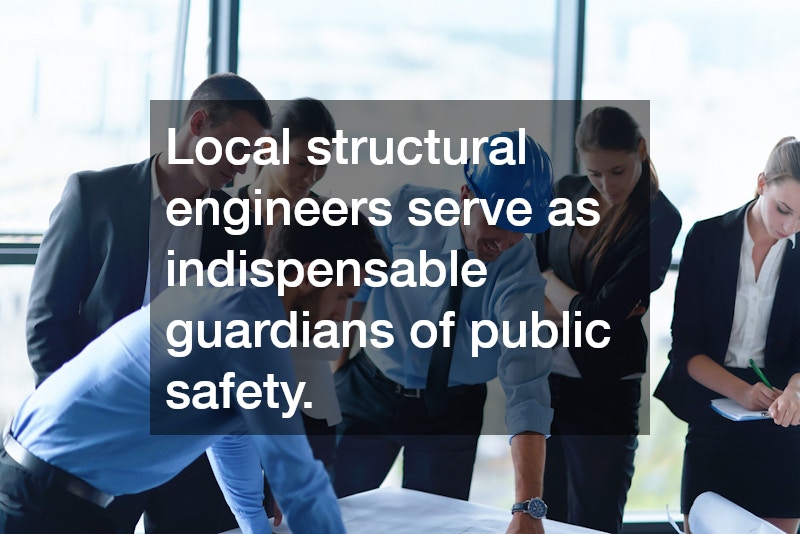
Local structural engineers serve as indispensable guardians of public safety, applying rigorous scientific principles, advanced modeling technologies, and detailed code knowledge to prevent structural failure. By conducting thorough integrity analyses, designing redundant load-bearing systems, performing non-destructive diagnostics, and collaborating closely with design teams, structural engineers ensure that our built environment remains safe, durable, and resilient for generations to come.